

Tax compliance in India has traditionally involved large volumes of invoices, reconciliations, returns, supporting documents, and deadlines. As tax systems become increasingly digital, artificial intelligence (AI) is changing how businesses, accountants, Chartered Accountants, and tax professionals manage these workflows.
AI-powered tax compliance tools can connect accounting and ERP systems with GSTN and e-filing portals through secure APIs. They can automate data processing, identify anomalies, simplify reconciliation, and highlight potential tax risks before they become larger compliance issues.
The result is a shift from a largely manual and retrospective process toward a more automated, real-time, and predictive approach to tax compliance.
What Is AI-Powered Tax Compliance?
AI-powered tax compliance refers to the use of technologies such as machine learning, Optical Character Recognition (OCR), Natural Language Processing (NLP), predictive analytics, and automated reconciliation engines to simplify tax-related processes.
Some of the key applications include:
Extracting information from invoices using OCR
Detecting duplicate claims and incorrect tax rates
Matching purchase registers with government data
Forecasting potential tax liabilities
Identifying high-risk transactions
Automating parts of GST and income tax compliance workflows
Instead of relying entirely on manual data entry and verification, professionals can use AI to process large amounts of financial data faster and identify issues that may otherwise take significant time to detect.
How AI Connects Accounting Systems With Tax Portals
A typical AI-enabled tax compliance workflow can connect company ERP or accounting data to government portals through a secure API architecture:
Company ERP/Data → Secure API Connection → AI Processing Layer → GSTN / Income Tax Portal
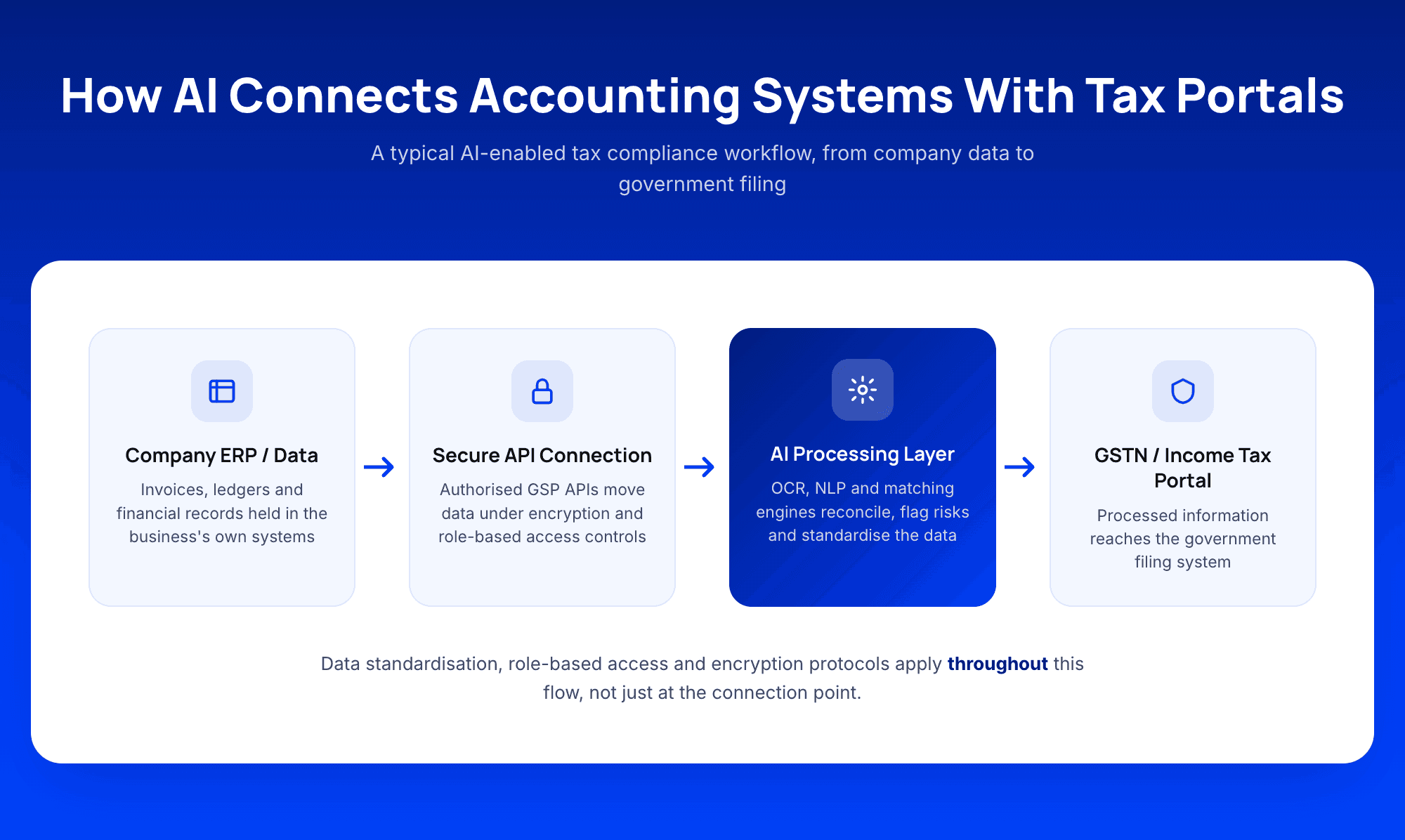
The technical setup can include authorised GST Suvidha Provider (GSP) APIs, standardised data formats, role-based access controls, and encryption protocols.
This architecture allows financial information to move through different stages of processing while maintaining controls over access and data security.
How AI Can Improve GST Compliance
GST compliance involves multiple recurring activities, particularly reconciliation and invoice-level verification. AI can automate several of these processes.
1. Automating GSTR-2B Matching
AI-based matching engines can compare purchase registers with GSTR-2B data on a regular basis. This can help identify mismatches faster and reduce the amount of manual reconciliation required.
2. Identifying Defaulting Vendors
AI can flag suppliers that fail to file their GSTR-1 returns on time, helping businesses identify potential compliance risks within their vendor base.
3. Identifying Invalid ITC
Automated systems can flag mismatched or potentially invalid invoices before Input Tax Credit (ITC) is claimed.
4. Automating E-Invoice Generation
AI-enabled workflows can also use automated triggers to generate e-invoices during billing cycles, reducing manual intervention.
How AI Can Improve Income Tax Compliance
AI is not limited to GST. Similar technologies can support several income tax compliance activities.
TDS Matching
AI can reconcile internal TDS records with Form 26AS data on a recurring basis, helping identify discrepancies earlier.
Automated Expense Classification
Machine learning can help classify expenses into categories such as capital expenditure and revenue expenditure.
Tax Risk Identification
AI systems can identify transactions that differ significantly from established industry patterns and flag them for professional review.
Drafting Responses to Tax Notices
Generative AI can also assist in preparing initial drafts of responses to tax department notices. These drafts still require review by a qualified professional before being finalised.
Building a Secure AI Tax Compliance Workflow
Automation is useful only when the underlying process is secure and properly controlled.
A robust AI tax compliance workflow should consider:
Secure API Integration: Accounting software can connect to government portals through authorised GSP APIs.
Data Standardisation: Financial data can be converted into standard formats such as JSON before analysis.
Role-Based Access: Access to AI configurations and sensitive tax data should be restricted to authorised professionals.
Data Encryption: Financial information should be protected using appropriate encryption standards.
These controls become particularly important because tax workflows involve sensitive financial and business information.
Where AI Can Make the Biggest Difference
The impact of AI is particularly visible in repetitive, data-heavy compliance activities.
The source material estimates a 75% to 90% reduction in manual effort across AI-enabled tax workflows, driven by improvements in areas such as reconciliation, data ingestion, vendor profiling, and notice management.
Some key applications include:
Tax Area | AI Capability | Potential Impact |
|---|---|---|
GST Reconciliation | Fuzzy matching between GSTR-2B and purchase registers | Faster identification of mismatches and improved ITC review |
Income Tax Data Ingestion | OCR for Form 16, AIS/TIS and capital gains data | Reduces manual data entry and highlights mismatches |
Vendor Risk Profiling | Analysis of historical filing patterns | Helps identify potentially non-compliant suppliers |
Notice and Litigation Management | NLP-based analysis of legal text and case law references | Helps accelerate initial drafting and review |
The source specifically notes that AI-based GST reconciliation can process thousands of data lines quickly and achieve high matching accuracy, while intelligent OCR can extract information from tax documents and identify discrepancies.
AI-Powered Tax Compliance and Accounting Tools
The market now includes a range of platforms that use AI, OCR, machine learning, NLP, and API-based integrations to support different parts of tax and accounting workflows.
Core Compliance and Filing Platforms
Clear: Clear offers compliance and tax-related workflows and uses AI to automate data extraction and matching between accounting records and GST data.
LEDGERS: LEDGERS is a cloud-based platform built around the GSTN API framework. Its AI capabilities include identifying invalid GSTINs, faulty HSN codes, and potential compliance risks.
EZTax: EZTax provides AI-supported tax filing workflows, including automated document data extraction and safeguards for ITR filing.
TrulyInvoice: TrulyInvoice focuses on accounting automation and uses AI-powered OCR to extract information from physical and digital invoices and sync the information with platforms such as Tally Prime.
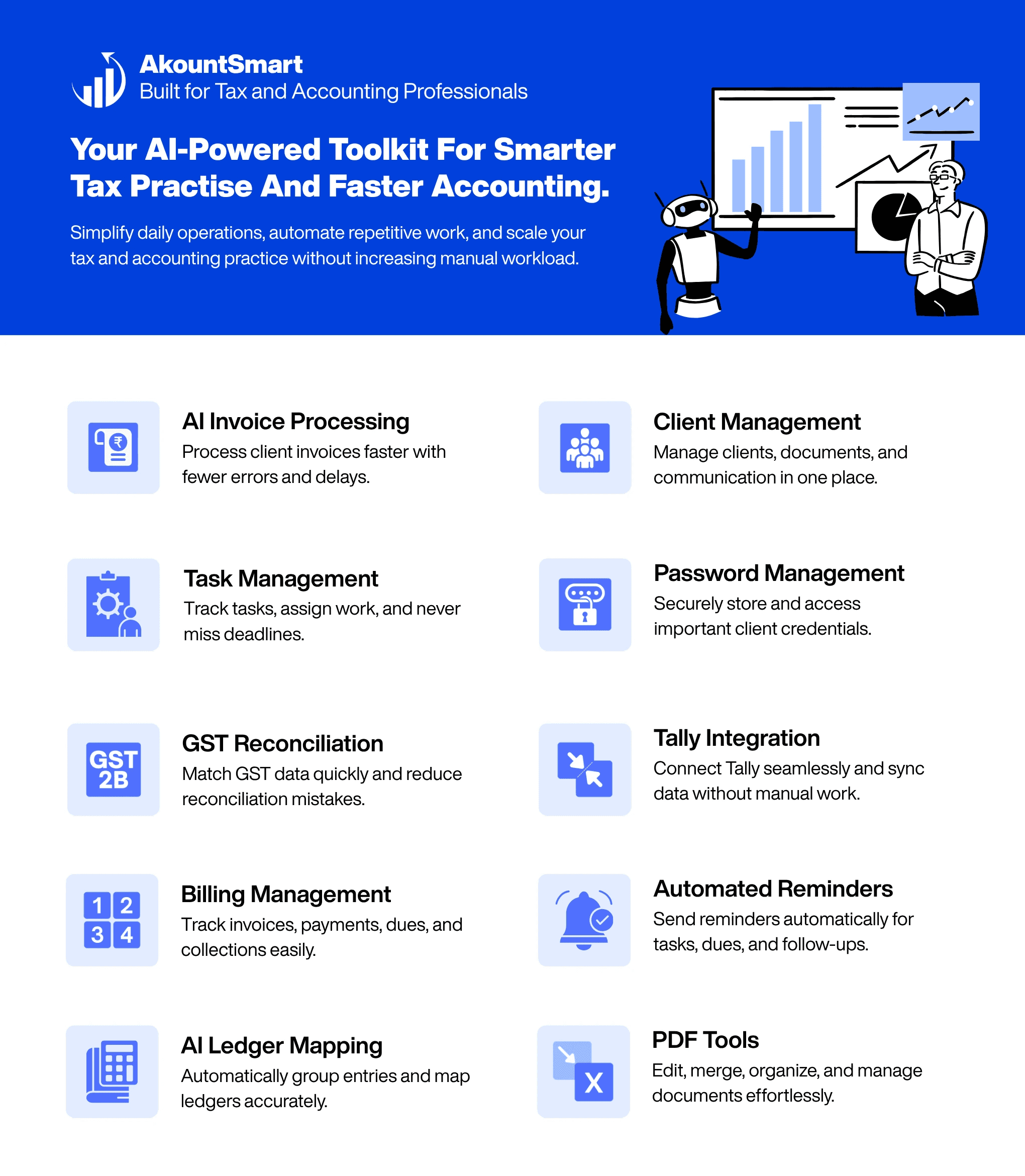
AkountSmart: AkountSmart can be used as part of an AI-enabled accounting and tax compliance workflow, particularly for GST reconciliation, AI-powered invoice processing, and Tally integration. These capabilities can help accounting professionals reduce repetitive data work and streamline their day-to-day compliance processes.
Enterprise and Tax Advisory Solutions
EY India AI Tax Hub / India Tax Platform: Designed for larger organisations and multinational businesses, these solutions use AI agents for areas such as withholding tax, scenario planning, and litigation workflows.
TaxBotGPT.AI: This AI tax copilot focuses on Indian tax professionals and uses context-aware models to assist with draft responses to income tax and GST notices and map relevant judicial precedents.
The right combination of tools depends on the size of the organisation, the complexity of its tax operations, and the specific workflows that need automation.
What Are the Limitations of AI in Tax Compliance?
Despite its capabilities, AI should not be treated as a completely autonomous tax professional.
There are several important limitations.
1. Tax Laws Keep Changing
The CBDT and GST Council regularly issue notifications, amendments, and clarifications. If an AI system is not updated with the latest regulatory changes, it may produce outdated information.
2. Tax Decisions Can Be Fact-Specific
Some tax matters depend on the specific facts and circumstances of a transaction. AI may not always be able to correctly interpret subjective legal or business considerations.
3. Human Review Remains Essential
AI-generated calculations, filings, drafts, and recommendations should be reviewed by qualified professionals before submission or use in formal tax representations.
The source specifically identifies professional review by a Chartered Accountant or tax expert as essential for finalising calculations and legal representations.
Best Practices for Using AI in Tax Compliance
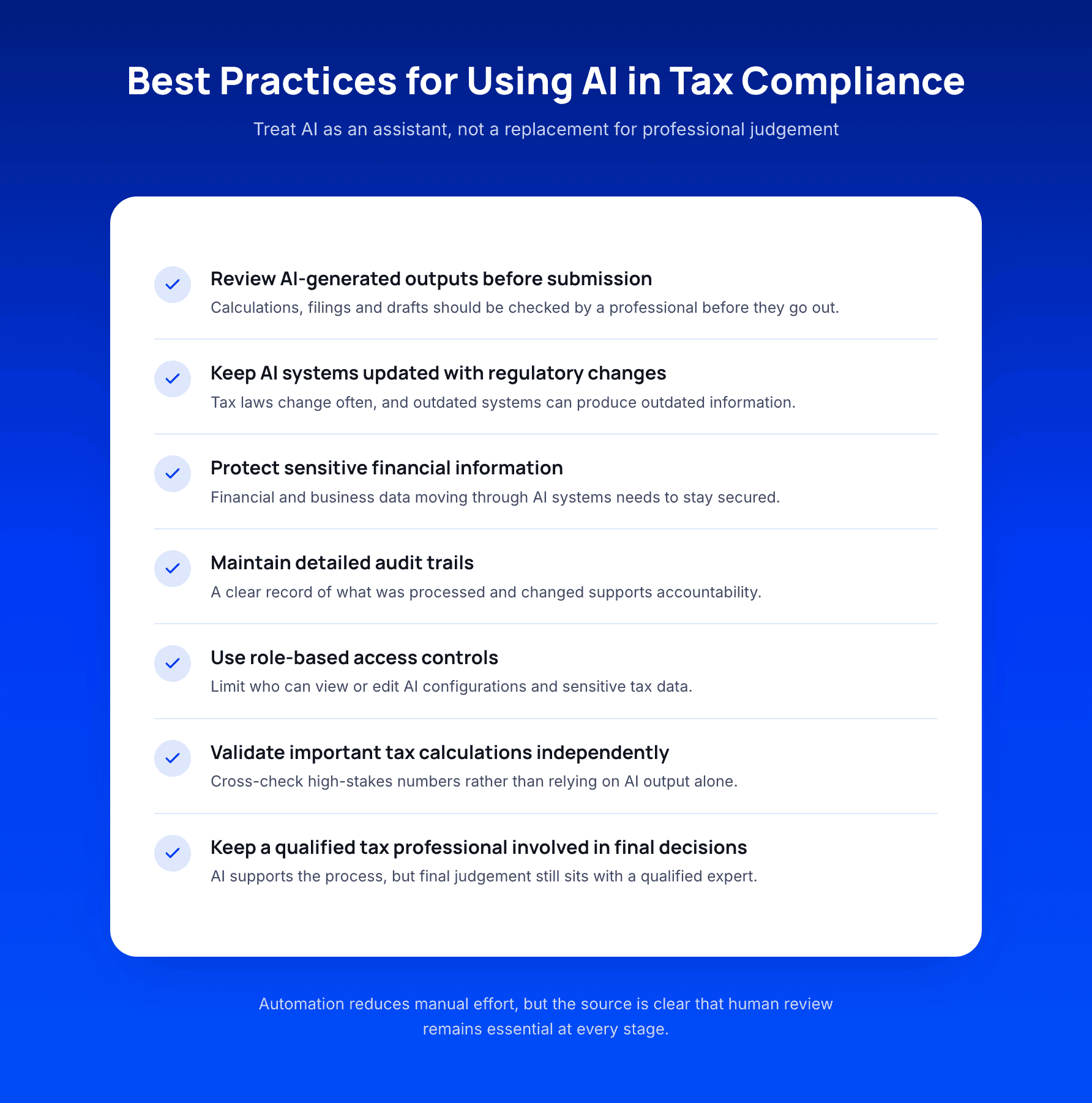
Businesses and accounting professionals can get more value from AI by treating it as an assistant rather than a replacement for professional judgement.
Some important practices include:
Review AI-generated outputs before submission
Keep AI systems updated with regulatory changes
Protect sensitive financial information
Maintain detailed audit trails
Use role-based access controls
Validate important tax calculations independently
Keep a qualified tax professional involved in final decisions
Conclusion
AI is changing tax compliance from a largely manual process into a more automated and data-driven workflow.
GST reconciliation, invoice processing, TDS matching, document extraction, vendor risk analysis, and tax notice management are all areas where automation can reduce repetitive work and help professionals identify issues earlier.
At the same time, AI does not eliminate the need for tax expertise. Tax laws continue to evolve, and many compliance decisions depend on context and professional judgement.
The most practical approach is therefore a human-in-the-loop model, where AI handles repetitive data-heavy tasks while accounting and tax professionals remain responsible for reviewing outputs and making final decisions.
For accounting firms and tax professionals, the opportunity is not simply to automate tax compliance. It is to spend less time on repetitive data processing and more time on analysis, advisory, and client service.
FAQ
What is AkountSmart and who is it for?
AkountSmart is an AI-powered tax and accounting toolkit designed for tax professionals, accountants, and growing businesses. It helps streamline compliance, automate workflows, and manage financial operations efficiently.
Do I need technical experience to use AkountSmart?
How secure is my data on AkountSmart?
What kind of support do you offer?
Can I upload and manage documents within the platform?
How does AkountSmart help improve compliance accuracy?