

Financial management plays a central role in how businesses make investment, financing and operational decisions. From managing liquidity and capital structure to evaluating investments and deciding how profits are distributed, strong financial management helps businesses make informed financial decisions.
For accounting professionals, students and business owners, understanding these fundamental concepts is essential.
This guide covers some of the core concepts of financial management and Indian accounting, including wealth maximization, Ind AS, liquidity, capital structure, leverage, capital budgeting, working capital and dividend decisions.
Financial Management and Indian Accounting Basics
1. What is the Primary Objective of Modern Financial Management?
The primary objective of modern financial management is wealth maximization.
Rather than focusing only on short-term profits, wealth maximization focuses on creating value for the firm’s owners and investors.
It influences major financial decisions such as:
Investment decisions
Financing decisions
Capital structure decisions
Dividend decisions
2. What Are Ind AS?
Ind AS, or Indian Accounting Standards, are the accounting standards used in India and are converged with International Financial Reporting Standards (IFRS).
They provide a framework for the recognition, measurement, presentation and disclosure of financial information.
The source identifies ICAI, the Institute of Chartered Accountants of India, as the regulatory body issuing Accounting Standards in India.
3. What is the Role of ICAI?
The Institute of Chartered Accountants of India (ICAI) plays an important role in the Indian accounting framework.
The source identifies ICAI as the body that issues Accounting Standards in India.
For accounting professionals, staying familiar with applicable accounting standards is essential for preparing and interpreting financial statements.
4. What is NFRA?
NFRA, or the National Financial Reporting Authority, makes recommendations to the Ministry of Corporate Affairs on accounting policies.
Its role is an important part of India’s financial reporting and accounting regulatory framework.
5. What is Liquidity?
Liquidity refers to a firm’s ability to meet its short-term obligations.
A business needs sufficient liquidity to meet expenses and liabilities as they become due.
For example, a company may have substantial assets and still face short-term financial pressure if it does not have enough readily available funds to meet its immediate obligations.
6. What is Amortisation?
Under Ind AS 38, amortisation refers to the systematic process of allocating the cost of an intangible asset over its useful life.
Examples of intangible assets can include certain:
Software
Patents
Copyrights
Licences
The objective is to allocate the asset’s cost systematically over the period in which it provides economic benefits.
Capital Structure and Leverage
Capital structure and leverage are important components of financial decision-making.
7. What is Capital Structure?
Capital structure refers to the mix of long-term debt and equity used by a firm.
A business can finance its long-term requirements through different combinations of:
Equity
Long-term debt
Other long-term financing sources
The composition of these sources forms the company’s capital structure.
8. What is Financial Leverage?
Financial leverage measures the relationship between EBIT and EPS.
Here:
EBIT = Earnings Before Interest and Tax
EPS = Earnings Per Share
Financial leverage helps in understanding how changes in operating earnings can affect earnings available to shareholders.
9. What is Opportunity Cost?
Opportunity cost is the cost of the next best alternative investment opportunity that is foregone.
In simple terms, when a business chooses one investment, it gives up the opportunity to invest those resources elsewhere.
The return that could have been earned from the next best alternative represents the opportunity cost.
10. What is Cost of Capital?
Cost of capital is the minimum rate of return a firm must earn to satisfy its investors.
It is also commonly referred to as the hurdle rate.
Businesses can use the cost of capital as a benchmark when evaluating investment opportunities.
An investment expected to generate returns below the relevant hurdle rate may require closer examination before funds are committed.
11. What is the Modigliani-Miller Theory?
The Modigliani-Miller (MM) theory states that capital structure is irrelevant to a firm’s value in a frictionless market.
Under the assumptions of the theory, changing the mix of debt and equity does not affect the overall value of the firm.
The theory is an important foundation for understanding capital structure decisions and the relationship between financing and firm value.
Capital Budgeting and Investment Decisions
Capital budgeting involves evaluating long-term investment opportunities.
Businesses may need to decide whether to invest in new equipment, expand operations, develop new facilities or undertake other long-term projects.
Several important techniques are used to evaluate these decisions.
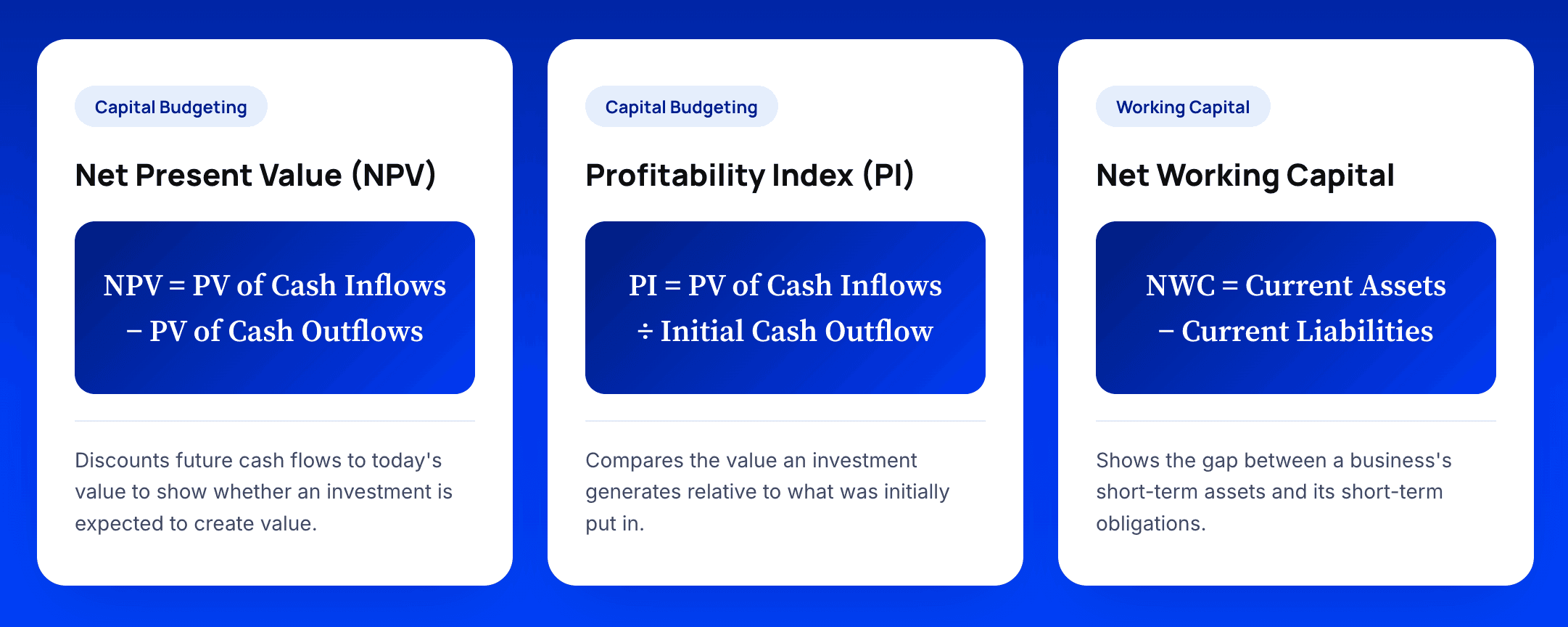
12. What is NPV?
NPV, or Net Present Value, calculates the present value of cash inflows minus cash outflows.
It accounts for the time value of money by discounting future cash flows to their present value.
The basic concept can be represented as:
NPV = Present Value of Cash Inflows − Present Value of Cash Outflows
NPV is widely used to evaluate whether an investment is expected to create value.
13. What is IRR?
IRR, or Internal Rate of Return, is the discount rate at which the NPV of a project becomes zero.
It provides a percentage-based measure of the potential return associated with an investment.
14. What is Profitability Index?
The Profitability Index (PI) is the ratio of the present value of cash inflows to the initial cash outflow.
It helps compare the value generated by an investment relative to the amount initially invested.
A simplified representation is:
PI = Present Value of Cash Inflows ÷ Initial Cash Outflow
15. What is the Payback Period?
The payback period is the time required to recover the initial investment made in a project.
For example, if a company invests ₹10 lakh in a project and the expected cash flows allow it to recover the investment in four years, the payback period is four years.
The method is straightforward and focuses on how quickly the initial investment can be recovered.
16. What Are Mutually Exclusive Projects?
Capital expenditure projects that cannot be accepted simultaneously are called mutually exclusive projects.
For example, a company may have to choose between two alternative projects when undertaking both is not feasible.
In such situations, the business needs to evaluate the available alternatives using appropriate capital budgeting techniques.
Working Capital and Dividend Decisions
Financial management does not stop at long-term investments.
Businesses must also manage their day-to-day financial requirements and decide how profits should be distributed.
17. What is Net Working Capital?
Net working capital is calculated as:
Net Working Capital = Current Assets − Current Liabilities
It represents the difference between the company’s short-term assets and short-term obligations.
Effective working capital management helps businesses manage their short-term financial requirements.
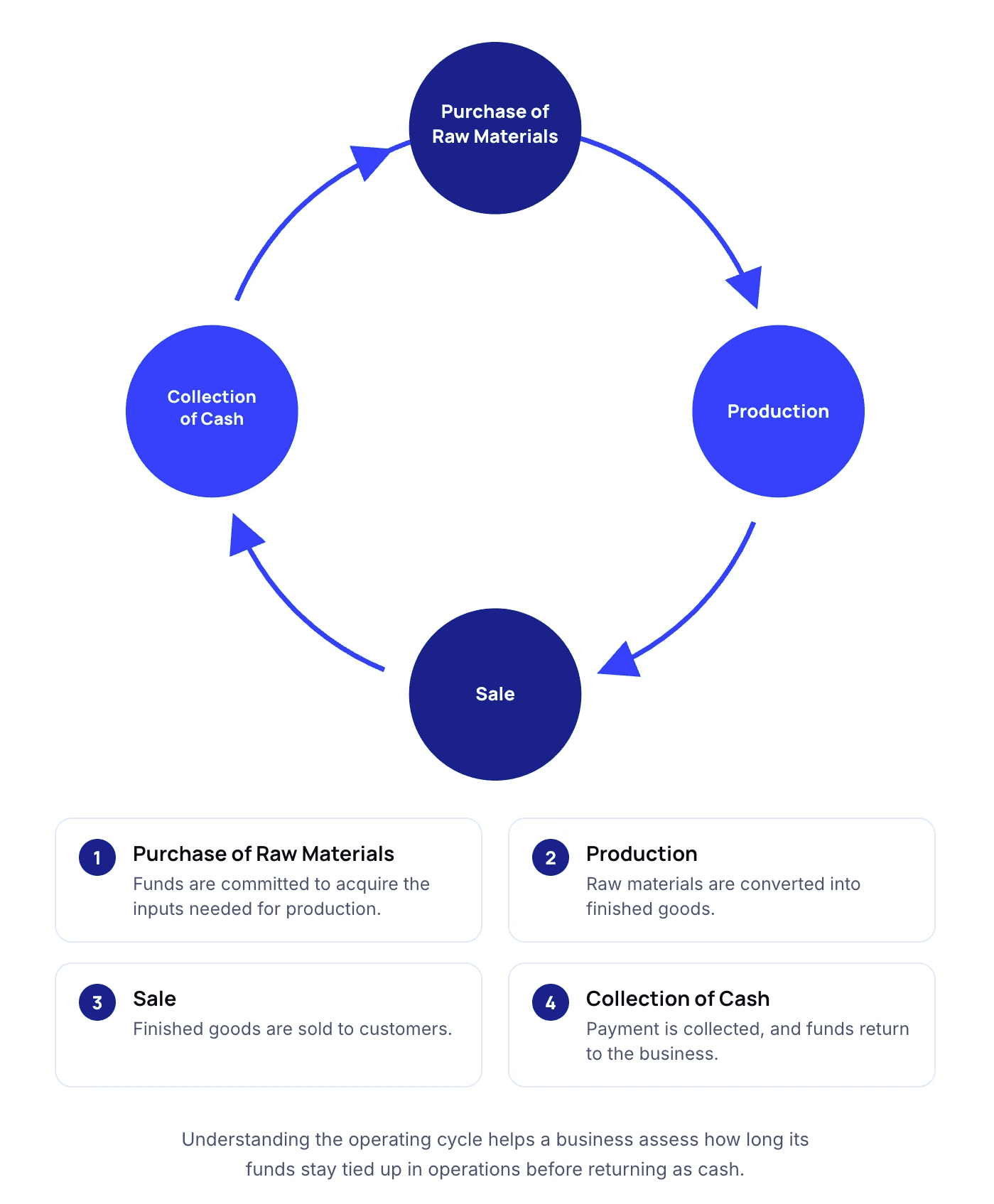
18. What is the Operating Cycle?
The operating cycle is the time gap between purchasing raw materials and collecting cash from sales.
A simplified operating cycle can involve:
Purchase of raw materials → Production → Sale → Collection of cash
Understanding the operating cycle helps businesses assess how long their funds remain tied up in operations.
19. What is Walter’s Model?
Walter’s Model explains that dividends are relevant and can act as an indicator of growth.
Dividend decisions therefore form an important part of financial management because they involve deciding how much of a company’s profits should be distributed to shareholders and how much should be retained in the business.
20. What Are Dividends?
Dividends are corporate profits distributed to shareholders.
Companies may distribute a portion of their profits to shareholders while retaining the remaining amount for purposes such as:
Business expansion
New investments
Working capital
Debt repayment
The balance between distribution and retention is an important financial decision.
21. What Was Dividend Distribution Tax?
Dividend Distribution Tax (DDT) was a tax applicable to dividend distributions by companies.
The source notes that DDT was abolished in India from April 2020, following which dividends became taxable in the hands of shareholders.
This change shifted the tax treatment of dividends from the company-level distribution framework to taxation in the hands of shareholders, subject to the applicable provisions.
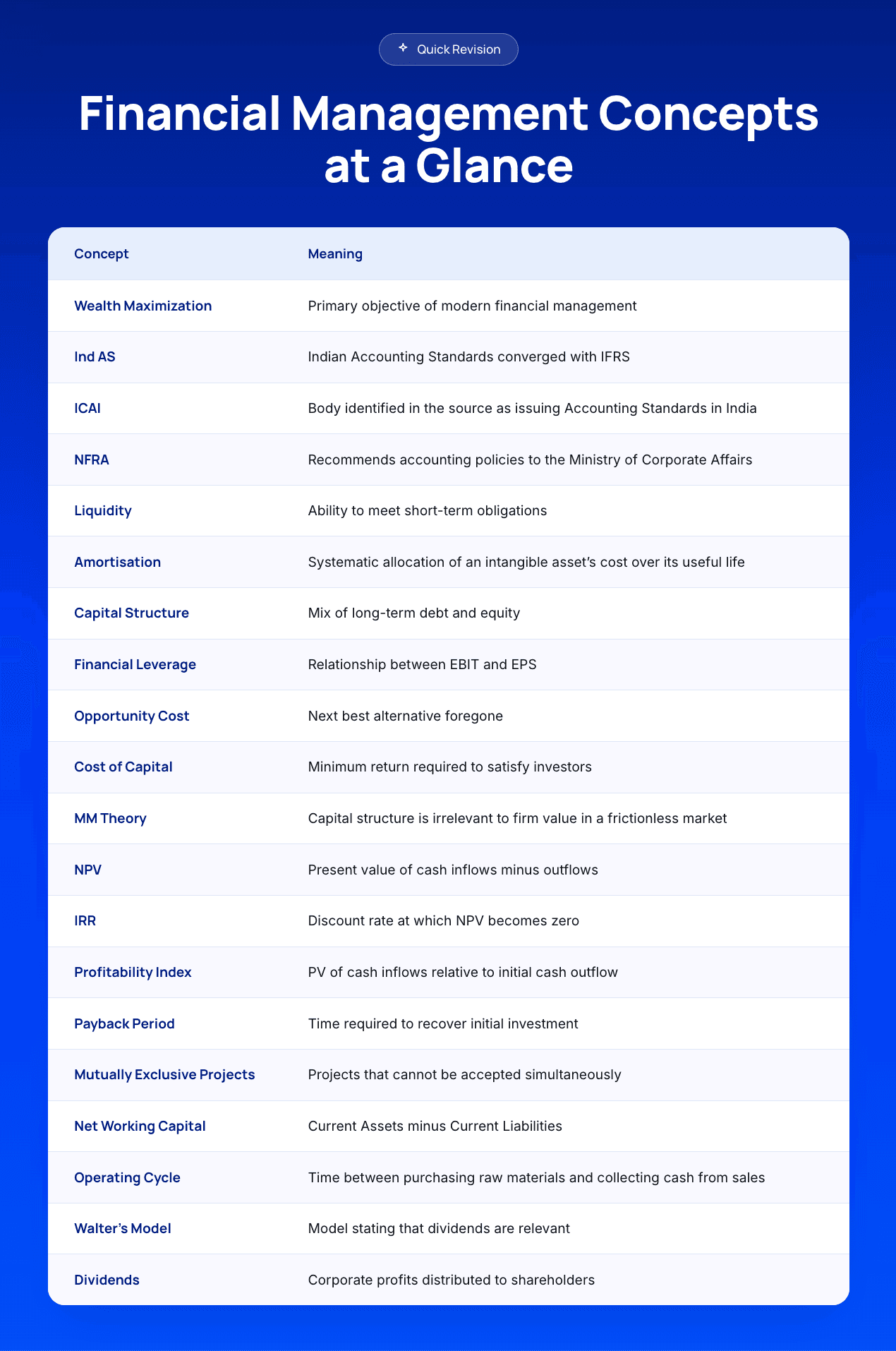
Quick Revision: Financial Management Concepts at a Glance
Why These Concepts Matter
Financial management concepts may appear theoretical, but they directly influence business decisions.
A finance professional may need to answer questions such as:
Does the business have enough liquidity?
Should the company use debt or equity to finance an investment?
Is a proposed project financially viable?
How quickly will an investment recover its initial cost?
What is the opportunity cost of choosing one investment over another?
How much working capital does the business require?
How much profit should be distributed as dividends?
Understanding concepts such as NPV, IRR, capital structure, cost of capital and working capital provides the foundation for answering these questions..
Frequently Asked Questions
What is the primary objective of financial management?
The primary objective of modern financial management is wealth maximization.
What is capital structure?
Capital structure is the mix of long-term debt and equity used by a firm.
What is the difference between NPV and IRR?
NPV measures the present value of cash inflows minus outflows, while IRR is the discount rate at which the project’s NPV becomes zero.
What is net working capital?
Net working capital is current assets minus current liabilities.
What is an operating cycle?
It is the time gap between buying raw materials and collecting cash from sales.
What are mutually exclusive projects?
These are capital expenditure projects that cannot be accepted simultaneously.
Conclusion
Financial management connects accounting information with important business decisions.
From wealth maximization and liquidity to capital structure, leverage, capital budgeting, working capital and dividend decisions, these concepts form the foundation of sound financial management.
For accounting professionals and business owners, understanding these fundamentals is not just useful for examinations. It helps build a stronger understanding of how businesses finance operations, evaluate investments and create long-term value.
Disclaimer: This article is based on the uploaded Financial Management Q&A source and is intended for educational and reference purposes. Specific accounting, tax and regulatory matters should be evaluated with reference to the applicable laws, standards and professional guidance.
FAQ
What is AkountSmart and who is it for?
AkountSmart is an AI-powered tax and accounting toolkit designed for tax professionals, accountants, and growing businesses. It helps streamline compliance, automate workflows, and manage financial operations efficiently.
Do I need technical experience to use AkountSmart?
How secure is my data on AkountSmart?
What kind of support do you offer?
Can I upload and manage documents within the platform?
How does AkountSmart help improve compliance accuracy?